
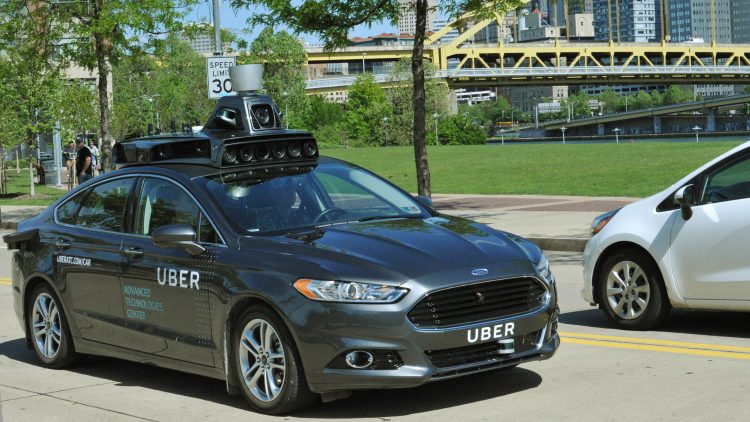
Uber’s Pittsburgh self-driving pilot may be more experimental than most people realise. Anyone requesting an Uber ride in a 12-sq mile area in the center of Pittsburgh might now be randomly allocated a self-driving Ford Fusion rather than a human-operated vehicle, writes The Guardian.
But passengers riding in Uber’s computer-controlled cars today might be surprised at just how experimental the technology is. According to documents obtained by the Guardian under public records laws, until as recently as June anyone not employed by Uber riding in one of its autonomous vehicles (AVs) had to sign a legal document waiving the company of any liability for their injury or death.
One senior Pittsburgh police officer signed a waiver on 23 June:
“I acknowledge that some or all of the AVs in which I ride are in a development phase, are experimental in nature, and that riding in an AV may involve the potential for death, serious injury, and/or property loss.” The document was required by Uber’s Advanced Technologies Center (ATC), a research hub that in early 2015 hired dozens of robotics experts from nearby Carnegie Mellon University. Since then the ATC has been working furiously to catch up with the likes of Google and Tesla in self-driving technology – a task Uber CEO Travis Kalanick has described as “basically existential for us”. Over the summer, ATC ran a “Friends & Family” program that allowed contacts and family members to ride in the same self-driving cars that are now being used in the public trial.
The legal document obtained by the Guardian details what might have gone wrong on any ride. “Risks associated with riding in an AV may include, without limitation, those caused by equipment failure, development vehicle operators or other safety drivers, actions of other motorists, weather, temperature, road conditions, negligence or human error,” it says.
“Nobody has set up software that can reliably drive a car safely without a human,” Kalanick told Bloomberg Businessweek in August. “We are focusing on that.” In the current self-driving Ubers, a human is always in the driver’s seat to cope with technical failures and unexpected situations – such a family of geese crossing the road.
At the moment, self-driving Ubers can be hailed between 7am and 10pm, and only in a downtown area that has previously been meticulously mapped to within centimeters. Uber would not confirm whether the pilot program would operate in challenging weather conditions like heavy rain, fog, snow or ice. All rides are currently free during the trial. While transporting passengers does not materially affect the way autonomous vehicles navigate or drive, it does allow Uber to see how riders react to being driven by a machine.
Uber admits it is filming passengers, inside and outside the car, to inform how it develops the technology. Picking up and dropping off customers may be trickier without a human driver to wave to, for example, or to point out a safe place to stop. During the Friends & Family program, users were obliged to assume complete responsibility for riding in Uber’s AVs.
Public passengers today do not have to sign any such waiver, and Uber confirmed to the Guardian that all riders in self-driving Ubers are covered by $5m of accident insurance, in line with pending legislation in Pennsylvania. “It’s possible that, by not charging for rides, Uber’s pilot program avoids Pennsylvania’s rules for taxicabs,” says Bryant Walker-Smith, a professor at the University of South Carolina. “Courts generally hold that providers of transport for hire have a heightened responsibility for the safety of their passengers. However, I’d expect a court to hold Uber to a similarly high standard if its program were to result in injury.”
The blistering pace of Uber’s technology development has taken even self-driving experts by surprise. Anthony Levandowski, who built Google’s first self-driving car, went on to found an autonomous trucking start-up called Otto. In September, he joined Uber as a vice-president in charge of self-driving technology.
Speaking to the Guardian shortly before he was hired, Levandowski said: “Uber’s effort seems to be very logical. But it will take a long time for the tech to penetrate and be ubiquitous everywhere. It could take 25 years.” Kalanick wants driverless self-driving Ubers much quicker than that. “We are going commercial,” he told Bloomberg Businessweek. “This can’t just be about science.”